

Bezel Engagement Ring: Pros, Cons and Bezel vs Prong Settings

A bezel engagement ring holds the center diamond in a continuous rim of metal instead of prongs, so the stone's edge is fully protected and nothing on the ring can snag. Compared with a prong setting, a bezel is more secure and easier to live with every day, shows slightly less of the diamond's side and lets in slightly less light, and usually costs a little more because it uses more gold and more setting work. For an active life, a fragile shape such as a pear or marquise, or a clean modern look, a bezel is often the better choice.
Below, we answer the questions couples actually ask before choosing, including the ones most setting guides skip: how much sparkle you really lose, whether a wedding band will sit flush, and what the price difference looks like on two comparable rings.
What is a bezel setting on an engagement ring?
In a bezel setting, a jeweler shapes a thin collar of gold or platinum to the outline of the stone, then presses and burnishes the top edge of that collar over the diamond's girdle (its outer rim). The stone is held all the way around rather than at four or six points. It is one of the oldest ways to set a stone, used for centuries on rings and seals long before the modern prong solitaire appeared, which is why a bezel reads as both ancient and very contemporary.
There are three versions you will see:
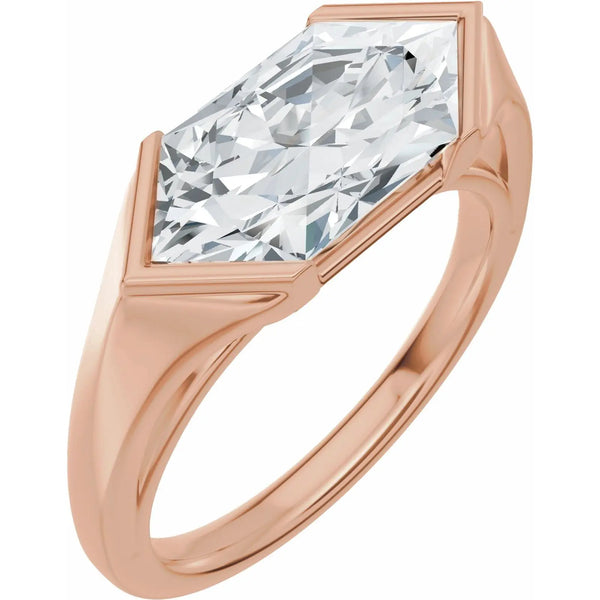
- Full bezel. The metal surrounds the entire stone. Maximum protection and the sleekest, most architectural look, as on the Nuage 2 1/2 CTW Lab-Grown Diamond Bezel Engagement Ring or the octagonal Étincelle Diamond Bezel Solitaire Ring.
- Half (or partial) bezel. Two curved sections of metal hold the stone at the ends or sides and leave the rest open. More light, more visible diamond, still very secure. The Encore 2 1/2 CTW Lab-Grown Oval Diamond Half-Bezel Engagement Ring is a good example.
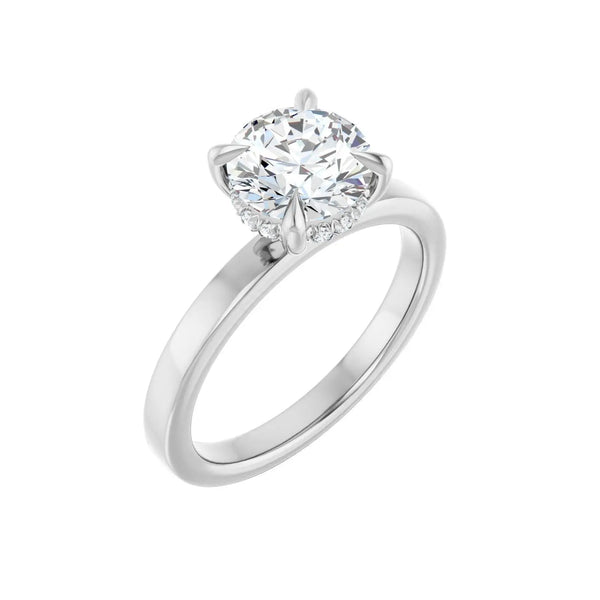
- Bezel-style prongs. A hybrid: claw prongs sit inside a delicate open rim, so the ring has a bezel's soft outline and a prong's light. The Belle Oval Diamond Claw-Prong Bezel-Style Solitaire works this way.

Bezel vs prong engagement ring: what is the difference?
The honest comparison, setting by setting:
| Bezel setting | Prong setting | |
|---|---|---|
| Security | Highest: the whole girdle is covered, so chips on the edge are very unlikely | Good when prongs are checked; a bent or worn prong can release the stone |
| Snagging | None: smooth edge, safe with knitwear, hair and gloves | Prong tips can catch, especially on a high setting |
| Sparkle | Very slightly less light from the sides; face-up brilliance is still strong | Maximum light and visible diamond from every angle |
| Look | Modern, sculptural, often lower on the finger | Classic, airy, the diamond appears to float |
| Maintenance | Rarely needs tightening; clean under the rim with a soft brush | Prongs should be checked every 6 to 12 months |
| Price | Usually a little more (more metal, more labor) | Usually a little less for the same stone |
A real example from the Maison's own catalog, at the time of writing: the Aube 1 CTW Lab-Grown Diamond Half-Bezel Solitaire starts at $1,170 and the Iris 1 CTW Lab-Grown Diamond Claw-Prong Solitaire at $1,120. Same diamond weight, a difference of about $50. On most solitaires the setting style changes the price far less than the diamond itself does, so choose the setting for how she lives, not to save money. For the full picture of where budget really goes, see the 4Cs of diamonds, simply explained.
What are the disadvantages of a bezel setting?
- A little less light from the side. A diamond's sparkle comes mostly from light entering the top and bouncing off the lower facets, so the loss is small. It shows most on small stones under about 0.5 carat, where the rim takes up a bigger share of what you see.
- The rim covers a sliver of the stone. Usually well under a millimeter, but it can make a diamond's measured spread look a touch smaller from the top. In white gold or platinum, the bright rim often frames the stone and makes it look as large or larger.
- Metal color shows more. A yellow gold bezel reflects warmth into the diamond. That flatters near-colorless grades but means a very white (D to F) diamond will look slightly warmer than it would in white prongs.
- Resetting takes more work. Removing a stone from a bezel, to upgrade it later for example, means carefully lifting the rim and usually remaking it. Plan for that if an upgrade is likely.
- A dent is visible. A hard knock can dent soft gold. A jeweler can usually reshape a bezel, but it is worth choosing a substantial rim.

Full bezel or half bezel: which should you choose?
Choose a full bezel if she works with her hands (nurses, teachers, surgeons, anyone who lifts, climbs or cooks a lot), if the shape has delicate points, or if she loves a minimal, sculptural look. Choose a half bezel if she wants most of the bezel's protection with more visible diamond and more light from the sides. On an oval, a half bezel at the two ends protects the most exposed points while leaving the long sides open, which is why it is so popular on ovals like the Douce Oval Diamond Half-Bezel Solitaire.
Which diamond shapes look best in a bezel?
- Marquise and pear: the bezel protects the fine points, the part most prone to chipping. See the Navette Marquise Diamond Bezel-Set Solitaire.
- Emerald cut: a polished rim echoes the long step facets for a clean, Art Deco line, as in the Miroir Emerald-Cut Diamond Bezel-Set Solitaire.
- Oval and elongated cushion: soft, modern and flattering on the finger, especially set east-west.
- Round: the most classic and the most forgiving on light loss, because a round brilliant returns so much light through the top.
Our diamond shapes guide compares how each shape faces up and what it costs per carat.
"For a first engagement ring, I like a half bezel on an oval or a full bezel on a round of about one carat in yellow gold: secure enough to forget about, and still unmistakably a diamond from across the table." — Héloïse Beucher
Will a wedding band sit flush with a bezel engagement ring?
It depends on how high the bezel sits. Many bezels are set low, and the rim is wider than the shank, so a perfectly straight band can leave a small gap or rub against the bezel. Before you buy, check three things: the height of the bezel above the shank (look at the side profile photo), whether the bezel overhangs the band, and the width of the shank. A slim band with a bezel-set diamond, like the Étincelle Diamond Bezel Stackable Ring, echoes the engagement ring without competing with it. Our guide on how to choose a wedding band for her covers contoured and curved options.

A buying checklist for a bezel engagement ring
- Look at the rim width from above. A rim of roughly 0.5 to 1 mm reads refined; much thicker and the ring looks heavy on a small stone.
- Check the profile. A low bezel is practical; a slightly raised one lets more light in and gives a band room to sit.
- Match metal to diamond color. Yellow gold flatters G to J colors; white gold or platinum keeps a D to F stone icy.
- Go a little bigger if the stone is small. Under about 0.5 carat, a half bezel or bezel-style prongs keep more of the diamond visible.
- Ask how upgrades work. If she may upgrade the center stone later, a prong or bezel-style prong setting is easier to reset.
- Confirm the ring size. Bezel settings often sit on a sturdier shank, so a precise size matters; use our ring size guide.
From the Maison
When we select bezel engagement rings, I look at three details most photos hide: the rim must be even all the way around, with no thin spots where it was burnished; the diamond must sit level, never tilted inside the collar; and the underside should be open enough for light and for cleaning. Every ring is set and ready to wear, inspected before it leaves us, shipped fully insured and delivered in our signature gift box. You can browse all bezel engagement rings, compare them with the full engagement ring collection, start from a setting in the ring builder, or book a private video appointment. The Maison is based in Florida and serves clients online only, across the United States and Canada.
Pieces to discover
Frequently asked questions
Are bezels safer than prongs?
Yes. A bezel covers the diamond's entire edge, so it protects against chips and cannot loosen at a single point the way one worn prong can. Prong settings are still very secure when they are checked once or twice a year.
Does a bezel setting make a diamond look smaller?
Not usually. The rim covers only a sliver of the edge, and in white metal it often frames the stone so it looks the same size or slightly larger. On very small stones, a half bezel shows more diamond.
Is a bezel setting more expensive?
Slightly, because it uses more metal and more setting work. On two comparable one-carat lab-grown solitaires in our catalog, the difference is about $50.
Are bezel engagement rings a fad?
No. The bezel is among the oldest ways to set a stone, and it has come back into fashion with the taste for clean, modern lines. Its practicality is what keeps it relevant.
Can a bezel engagement ring be resized?
In most cases, yes: resizing works on the shank, not the bezel. Very low bezels that touch the band, or rings with stones set down the shank, may limit how far a ring can be sized.
The takeaway
A bezel engagement ring trades a little sparkle from the sides for real peace of mind and a beautifully clean line. If she uses her hands, loves a modern look or has her heart set on a pear or marquise, a full or half bezel is a confident choice; if maximum light is her priority, choose prongs or a bezel-style hybrid. For a wider view, read our engagement ring settings guide.
Join the Maison's list and enjoy 15% off your first order. Sign up